You know how to run a meeting through a crisis, catch the detail everyone else missed, and keep a team steady when plans fall apart. People count on you for exactly that. The question worth asking is what it costs you to be the person who always has it handled.
Survival mode does not always look like a meltdown. For many capable leaders, it looks like competence. It looks like being early to every deadline, anticipating every problem, and rarely asking for help. This is high-functioning survival mode: a state where the outward performance looks strong while the internal system stays braced for the next thing to go wrong.
This matters because the pattern is easy to mistake for strength, and easy to miss until the cost shows up elsewhere—in your health, your relationships, or the way you lead when no one is testing you.
Key Takeaways
Success and strain can exist in the same person at the same time, and one does not cancel out the other.
Habits that once created safety or trust can quietly turn into a loop that is hard to step out of.
Small shifts in awareness—noticing the urge to fix, control, or prove—create more choice in how you lead.
What Does Survival Mode Look Like in a Capable Leader?
Survival mode in a capable leader rarely looks like falling behind. It can look like staying ahead of everything—anticipating problems before they surface, fixing what others miss, and carrying more responsibility than the job technically requires. Even while the calendar looks orderly and the results remain strong, the leader may operate with the persistent expectation that something will go wrong unless they stay ahead of it.
When Excellence Runs on Internal Pressure
Some leaders perform well because the work excites them. Others perform well because slowing down feels dangerous.
From the outside, both look like drive. Internally, they run on different fuel. One is built on curiosity and purpose. The other runs on a quiet, constant pressure to not let anything slip—a pressure that rarely gets acknowledged out loud.
Signs That Competence Is Concealing Strain
A few patterns may begin appearing together: difficulty relaxing when nothing is urgent, irritability that surfaces faster than it used to, and a habit of scanning for what might go wrong before acknowledging what went right. None of these is dramatic on its own. Together, they may indicate that vigilance has become a default rather than a response to a specific demand.
Leaders in this pattern may feel successful and depleted at the same time—a combination that rarely gets named because it does not fit the usual story of struggle. The article on being successful on paper while feeling disconnected in real life explores this exact gap.
Why Rest Can Feel Like Falling Behind
Rest can feel unsafe when usefulness has become the main source of value or stability. Stepping back does not feel restorative in that state—it feels like risk. The mind keeps working even when the body stops because, at some point, slowing down felt like losing ground.
Why Can Successful Habits Become a Survival Loop?
Habits that once protected you can turn into a survival loop that continues after the original pressure has passed. The American Psychological Association describes the stress response as a survival mechanism that prepares people to respond to threats. The concern is not that this response exists. It is that pushing through, staying alert, and refusing to let anything drop can become so automatic that they stop feeling like choices.
How Pushing Through Once Created Safety or Stability
The habits worked. They helped you earn trust, create stability, and move through difficult situations successfully. That history makes them difficult to question, even when the circumstances that required them have changed.
A useful response can become an automatic pattern if you repeat it long enough. Pushing through may still feel necessary even when pausing would lead to a better decision. Staying alert may feel necessary even when the immediate threat has passed.
The Rewards for Being the Person Who Always Handles It
Being reliable comes with real rewards—trust, promotions, respect, a reputation for steadiness. Those rewards reinforce the behavior, even when it starts to cost something internally.
This is part of what makes the loop so persistent. Chronic stress does not always look like distress from the outside; it can look like exactly the kind of consistency organizations value most.
How Competence Keeps the Cost Out of Sight
Competence can conceal strain because it continues producing evidence that everything is fine. Deadlines are met, problems are solved, and others keep relying on the leader. As long as the results remain strong, the pressure required to produce them is easy to minimize.
The cost may appear around the edges first: less patience, less presence outside work, difficulty resting, or the sense that everything will unravel if you stop managing it. The conversation on the hidden cost of being the one everyone counts on speaks directly to this dynamic.
Where Chronic Stress, Anxiety, and Burnout May Overlap
High-functioning survival mode is descriptive language used in this article, not a clinical diagnosis. It names a leadership pattern in which strong performance continues while the person feels driven by vigilance, urgency, control, or the need to remain useful.
That pattern may overlap with chronic stress, anxiety, or burnout, but the terms are not interchangeable. Naming it is not meant to diagnose the experience. It is to notice when effective leadership behaviors stop feeling intentional and start feeling compulsory.
Burnout's Occupational Definition and Its Limits
The World Health Organization defines burnout as an occupational phenomenon associated with chronic workplace stress and characterized by exhaustion, increased distance or cynicism toward work, and reduced professional efficacy. Those experiences do not always produce an immediate or visible decline in performance.
A leader may continue meeting expectations while feeling increasingly depleted or detached. Strong output does not rule out burnout, just as burnout does not explain every experience of internal pressure or over-functioning.
Are Your Strengths Serving the Work or Protecting You?
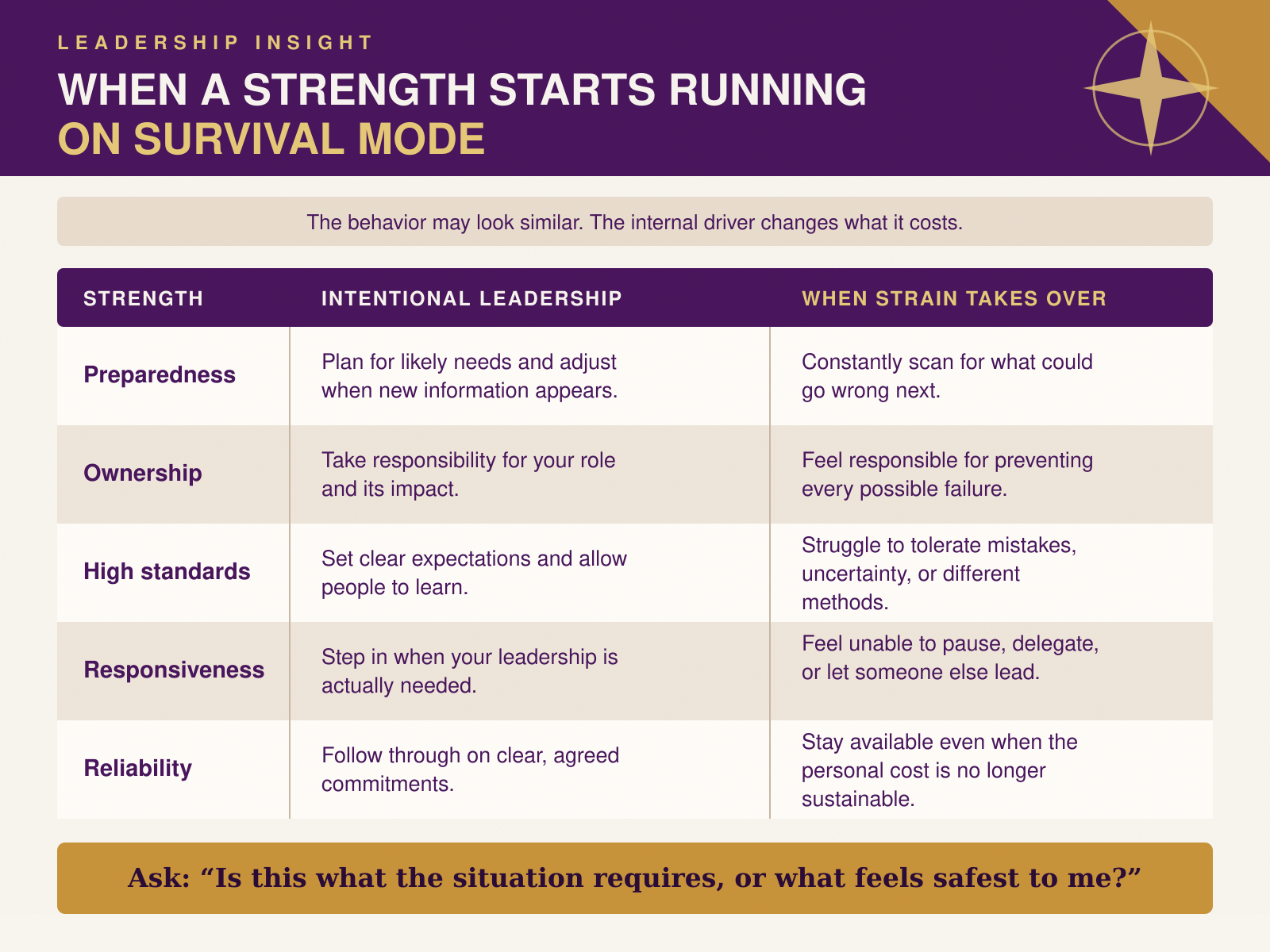
Comparison chart showing how preparedness, ownership, high standards, responsiveness, and reliability can shift from intentional leadership into strain-driven survival-mode patterns.
Your strengths can serve the work, protect you from discomfort, or do both at once—and telling the difference is where real discernment starts. High standards, quick problem-solving, and a strong sense of ownership are genuine assets. They only become a concern when they operate on autopilot, regardless of what the moment calls for.
Intentional Leadership vs. Reflexive Over-Functioning
Intentional leadership responds to what is actually needed. Reflexive over-functioning responds to discomfort—the itch to step in, fix, or control before anyone has asked.
Both can produce a good outcome. Only one leaves room for other people to grow, and for you to rest without guilt. This is close to what Armed with Ambition's STRONG framework calls Surrender: releasing the need to control what was never yours to carry in the first place.
Questions That Reveal What Feels Risky to Let Go
A few honest questions tend to surface more than most self-assessments:
What happens internally when someone else solves the problem instead of you?
Does rest actually restore you, or does it feel like falling behind?
Do your high standards serve the work, or do they guard against uncertainty you can't control?
Can people on your team struggle and learn without your intervention?
Who are you when your usefulness isn't being tested?
None of these have a single right answer. Sitting with them honestly is the point. The episode on self-worth tied to productivity digs into the last question in more depth.
How Can Leaders Create More Choice Under Pressure?
Leaders create more choice under pressure by noticing an automatic response before acting on it. Even a brief pause creates room to ask whether the impulse to fix, control, or take over fits what the situation actually requires. That pause is where reflex begins to turn into an intentional leadership decision.
Notice the Urge to Fix, Control, or Prove
The urge to step in often arrives before you have time to examine it. Naming the impulse by saying, “I want to fix this right now,” creates enough space to ask whether intervening is what the situation requires or simply what feels most familiar.
Make Room for Others to Contribute and Learn
Letting someone else own a problem, including its mistakes, builds their capability and your team's resilience. This connects to what many leaders discover is really a trust issue instead of a scheduling one. This theme is covered directly in the article on why your delegation problem may actually be a trust problem.
Choose a Response That Fits Your Values and the Moment
Not every situation calls for the same response. Sometimes stepping in is right. Sometimes stepping back serves the team and the moment better. The goal is to be honest about what is happening. That kind of transparency and grace turns reflex into intention.
Keeping Your Strength Without Carrying Everything
The habits that built your reputation—reliability, sharp instincts, the ability to stay steady when things get hard—are real strengths worth keeping. This isn't about becoming less capable or less ambitious.
It is about noticing when those strengths serve the work and when they quietly protect you from discomfort you haven't looked at directly. That noticing creates choice, and choice lets strength and rest coexist instead of competing.
You have already proven you can carry a lot. The next step is deciding, on purpose, what is actually yours to carry.
What Is Your Leadership Running On?
If your leadership looks strong from the outside but feels driven by pressure, control, or the need to keep proving yourself, the STRONG Leadership Quiz can help you identify which pattern may need your attention now.
