Successful on Paper. Disconnected in Real Life.
On paper, everything is on track. The title is bigger than it used to be, your calendar is full of meetings that matter, and the people around you rely on your judgment. So why does the drive home feel like nothing happened at all?
Feeling successful but unfulfilled is not a contradiction to resolve; it is information about the gap between how you are performing and how you are actually living. High achievers are especially prone to missing this gap, because their output stays strong even as their internal experience quietly changes. Noticing that difference before it forces itself on you is a leadership skill in its own right.
This experience shows up as flatness where there used to be interest, irritability that surprises even you, and decisions made to satisfy expectations rather than to reflect what you want. None of that requires a crisis to matter.
Key Takeaways
Ongoing competence and responsibility can mask a growing disconnect from your own values and presence.
Feeling unfulfilled despite success does not automatically mean burnout, and it does not require exhaustion or failure to deserve attention.
Examining how you succeed does not mean abandoning ambition; it means checking whether your current path still reflects what you intend to build.
You Don’t Have to Be Failing for Something to Be Wrong
Something does not have to announce itself through a collapse before it deserves attention. It shows up as a felt experience: a low hum of unease that runs underneath a life that, by every external measure, is working.
Leaders are trained to trust outcomes over feelings. If the numbers are good and the team is functioning, the internal signal gets filed under "not urgent" and left there.
Why Does Strong Performance Make Discomfort Easy to Dismiss?
Strong performance creates a kind of evidence that overrides internal signals. When results are visible and repeatable, it becomes easy to assume that discomfort is either irrelevant or a personal flaw rather than useful information.
Competent people are used to solving problems, not sitting with them. A felt experience that has no clear cause and no obvious fix does not fit that pattern, so it gets minimized. The mind reasons: things are going well, so this feeling must be wrong. That reasoning protects the performance. It does not examine what the performance is costing.
Why Do We Wait for Something to Fall Apart?
We wait because falling apart gives permission that steady functioning does not. A missed deadline, a health scare, or a relationship rupture provides an unambiguous reason to stop and reassess.
Without that kind of event, reassessment can feel unearned, even self-indulgent. Many leaders describe needing a "big enough" reason before they will take their own discomfort seriously, as though quiet disconnection has to escalate into a visible failure before it counts as real.
Successful but Unfulfilled: When Performance Conceals Disconnection
Successful but unfulfilled describes a specific pattern among high achievers: competence and responsibility keep functioning normally while the internal sense of alignment, meaning, or presence quietly erodes. It is not a sign of ingratitude or hidden unhappiness in every successful person; it is a pattern worth naming because performance metrics do not track it.
How Can Competence and Responsibility Hide Misalignment?
Competence hides misalignment because it produces results regardless of whether the underlying direction still fits. A capable leader can execute a strategy, manage a team, and hit targets even after the reasons behind those goals have shifted or disappeared entirely.
Responsibility compounds this. People depend on you, so stepping back to ask whether the path still makes sense can feel like a luxury you cannot afford. The work gets done well. What gets skipped is the harder question of whether it still reflects what you actually want.
What Does Disconnection Look Like in Daily Life?
Disconnection often looks like autopilot: moving through familiar routines without the presence that used to accompany them. Days pass in a blur of competent execution with little memory of the details afterward.
Other markers include:
Irritability that surfaces faster than it used to, especially over small friction points
Emotional flatness, where wins and setbacks both register as muted
Reduced enjoyment of activities or relationships that once felt energizing
Decisions shaped primarily by what others expect rather than by personal conviction
None of these require a diagnosis. They describe a life running on management rather than engagement.
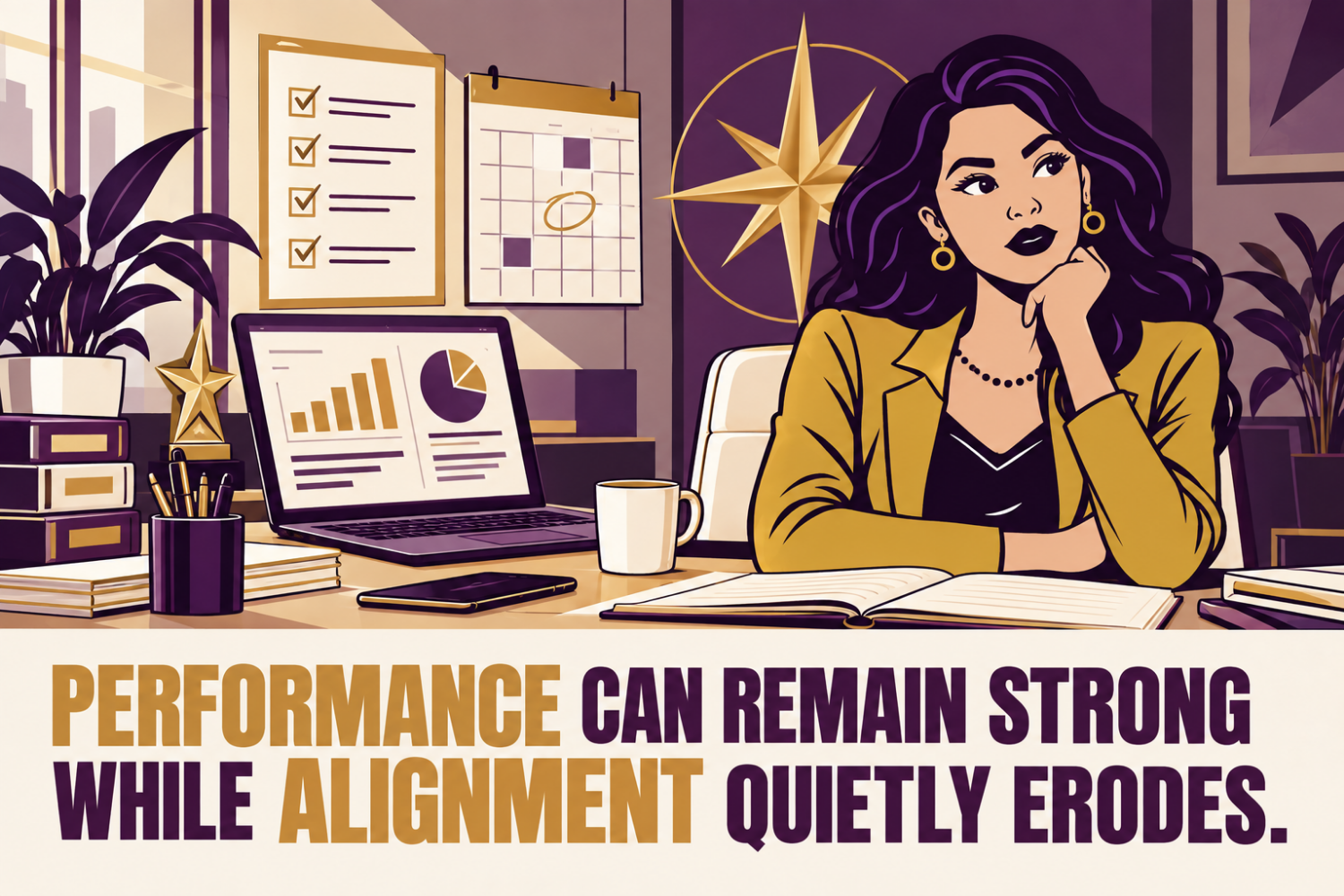
Illustrated professional at an organized desk with completed tasks and performance charts while appearing emotionally disconnected.
Does Disconnection Always Mean Burnout?
Disconnection and burnout can overlap, but they are not interchangeable. Burnout is specifically associated with chronic workplace stress and may include exhaustion, cynicism, or reduced professional effectiveness. Disconnection can extend beyond work and appear as distance from our values, relationships, choices, or daily lives.
A person may still be performing well while experiencing either one. The goal is not to diagnose the feeling from an article. It is to stop using continued performance as proof that the feeling does not deserve attention.
What Is Your Success Asking You to Ignore?
Every pursuit of success involves tradeoffs. The question worth asking is whether those tradeoffs remain intentional—and what your current version of success may be asking you to ignore. For some leaders it is rest; for others it is a relationship, a creative interest, or an honest conversation they have been postponing.
Whose Expectations Shape Your Decisions?
Many major decisions trace back to expectations that were never fully examined. A parent's definition of achievement, a mentor's approval, an industry's unspoken benchmarks: these shape choices long after the person who set them has stopped being relevant to your life.
Tracing a recent decision back to its source is revealing. Ask where the standard came from and whether it still holds up under your own scrutiny, separate from who first handed it to you.
What Has Become Harder to Notice or Enjoy?
Attention narrows under sustained performance pressure, and the first casualties are usually the smaller signals: a friend's tone of voice, a physical sense of ease, curiosity about something with no professional payoff. Fulfillment often lives in exactly those margins.
Leaders sometimes describe a related pattern in conversations about self-worth becoming tied to productivity, where identity narrows around output until anything unproductive starts to feel unjustified. Noticing what has quietly stopped registering as enjoyable is often the clearest early signal available.
What Can Values-Centered Leadership Reveal Before a Crisis?
Values-centered leadership surfaces the gap between what you are doing and what you actually intend before that gap forces a reckoning. Values function as a reference point; when decisions and daily behavior stop matching them, the mismatch is detectable long before a crisis makes it unavoidable.
How Do You Examine the Way You Succeed Without Rejecting Ambition?
Examining how you succeed does not require giving up the job, the relationship, or the responsibility that success has built. It means asking whether the methods, pace, and trade-offs behind that success still fit who you are now.
Ambition and alignment are not opposites. A leader can want more, build more, and lead at a high level while also adjusting how they get there: what they protect, what they delegate, and what they finally stop tolerating in service of appearances.
What Might Values-Centered Leadership Change?
Values-centered leadership tends to change decision-making speed and clarity before it changes any external outcome. Choices that once required agonizing become more obvious once measured against a clear standard instead of shifting external pressure.
The STRONG Leadership Framework was built around this kind of examination: helping leaders notice the patterns they carry into decisions, conflict, and daily work, so that success stops running on autopilot and starts running on intention.
Making Room to Examine How You Succeed
Making room for this kind of examination does not require a sabbatical or a dramatic reset. It requires deliberately slowing down long enough to ask what the current pace of success is actually costing, and whether that cost still feels acceptable.
A short, honest inventory helps: what decisions this month were driven by expectation rather than conviction, where irritability or flatness showed up, what got skipped because there was no time to notice it mattered. None of this has to change everything at once.
What it can do is interrupt the assumption that performance is the only evidence worth trusting. A leader who makes space for this kind of question, even briefly and imperfectly, starts building a different relationship with their own success.
What if the way you’re succeeding deserves examination?
If your leadership or life still looks successful but no longer feels aligned, the STRONG Leadership Quiz can help you identify which part of the framework may need your attention now.
